
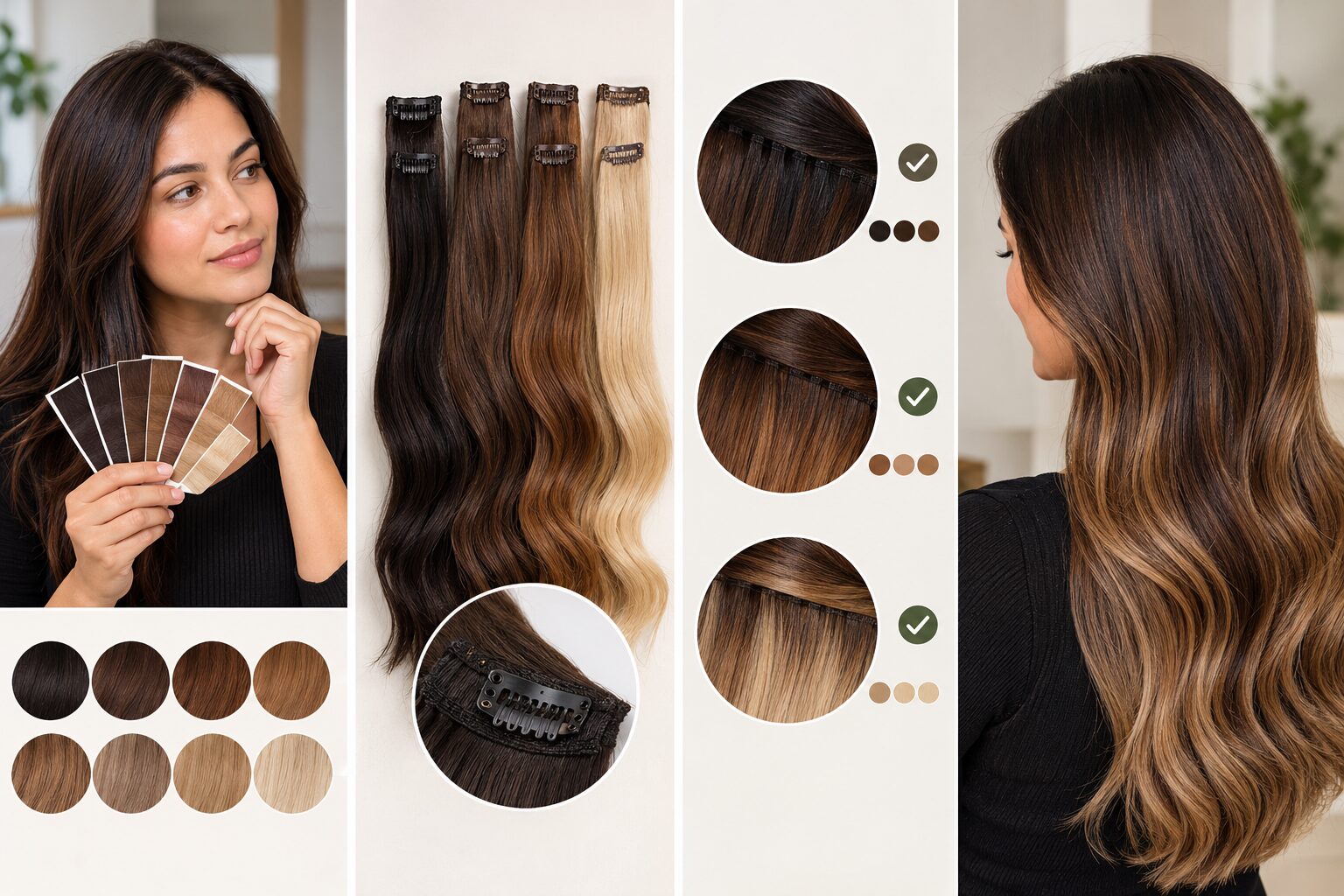
Choosing the right clip-in hair extension color match is about matching more than your hair’s overall color. The extensions should work with your natural roots, mid-lengths, ends, and undertones so they blend naturally.
Start by determining whether your hair has warm, cool, or neutral undertones, then compare the extensions to your mid-lengths and ends rather than your roots. If your natural hair has highlights, balayage, or sun-lightened ends, a blended or multi-tonal color may look better than a uniformly colored one. Also consider where you’ll place the extensions, since they have to sit beneath your top layer of hair.
This guide explains how to assess your shade, account for undertones, and choose clip-ins that complement your natural color and create a more cohesive finish.
Why Color Match Matters More With Clip-Ins
Clip-ins sit on top of your hair rather than being sewn or bonded, so a color that doesn’t match yours is much more noticeable. Even slightly warm or cool shades stand out, especially at the part where the clip-in meets your hair.
A solid clip-in hair extensions color match reduces that risk before you ever leave the salon. Instead of guessing from a photo or an online swatch, a stylist looks at your hair in person, under natural light, and compares it against several nearby shades rather than one. It’s the same in-person matching we do for every set of clip-in hair extensions Miami Metro clients take home.
Start With Your Natural Base Tone and Undertones
The base color is a starting point, but undertones make all the difference. Two people could have the same base color but look completely different if one has warm golden undertones and the other has more ash or neutral tones.
This is why a proper clip-in hair extensions color match cannot be done from a screen alone. Photos and monitors shift color constantly, so an in-person consultation lets a stylist catch subtleties that a swatch chart or online order often misses.
Shade Blending for Root-to-End Variation
Most natural hair is not one solid color. Roots usually stay closer to your natural pigment, while mid-lengths and ends lighten gradually from sun exposure, heat styling, or previous color services.
A single-tone clip-in weft can look flat against that kind of natural gradient. Shade blending, sometimes called color melting, combines two or three closely related tones within the same set so the transition feels gradual instead of abrupt. It is one of the more detailed parts of the matching process, and it usually takes a trained eye to get the ratio right.
Single Shade vs. Blended Wefts: Which Should You Choose?
| Factor | Single Shade | Blended Wefts |
| Best For | Uniform, single-tone hair | Balayage, highlights, sun-lightened ends |
| Application | Faster to select and clip in | Requires stylist input to combine tones |
| Natural Look | Can look flat on multi-tonal hair | Mimics natural root-to-end variation |
| Ideal Client | Recently colored, consistent shade | Color-treated, highlighted, or grown-out hair |
If your hair holds one consistent tone throughout, a single shade may blend just fine. If you have highlights, balayage, or noticeably lighter ends, blended wefts can create a more seamless transition than a single-tone set.
Matching Color for Bleached, Highlighted, or Color-Treated Hair
Bleached and heavily highlighted hair adds another layer to shade selection, since lightened strands often carry warmer or cooler tones than the rest of your hair. A stylist working on a clip-in hair extensions color match for color-treated hair typically pulls from multiple shades rather than one, then places them to echo where your natural highlights actually fall.
Timing matters too. Getting your extensions matched right after a fresh color service, rather than before one, tends to produce a more accurate and longer-lasting result, since it gives the stylist your true current shade to work from.
Common Color Match Mistakes to Avoid
A few habits tend to throw off even a well-intentioned clip-in purchase:
- Ordering online based on a shade number alone, without seeing the hair in person
- Matching to freshly dyed hair that will fade or shift within weeks
- Choosing one flat tone for hair that naturally lightens toward the ends
- Skipping an in-person consultation and relying only on photos
Avoiding these keeps your clip-ins from standing out for the wrong reasons once they’re clipped in and styled.
Why a Professional Consultation Makes the Difference
Professional color matching can account for details that are difficult to judge from photos alone. A stylist can assess your current color, undertones, previous color treatments, and the difference between your roots and ends before recommending a shade or blend. This reduces the chance of choosing extensions that look noticeably different once clipped into your hair.
During a consultation, your stylist examines your natural hair, discusses your color history, and recommends a shade or blend suited to your specific tone rather than a generic close match.
Ready for Clip-Ins That Actually Blend In?
A flawless clip in hair extensions color match comes down to more than a shade name. It takes an eye for undertones, an understanding of how your hair naturally shifts from root to end, and the patience to blend rather than settle for close enough. Schedule your free VIP consultation and get a color match built around your actual hair, not a guess from a chart.
Frequently Asked Questions
How many shades should be blended for clip-in extensions?
Most blends use two to three closely related tones, though the exact number depends on how much natural variation your hair already shows.
Can clip-ins be color matched for balayage or highlighted hair?
Yes, blended wefts are specifically designed to mimic multi-tonal hair like balayage and highlights, making them a good fit for color-treated clients.
Do gray hairs affect clip-in color matching?
Yes, gray coverage changes how a shade reads against your natural hair, so mentioning any gray during your consultation helps your stylist plan the blend accordingly.
Is an in-person consultation necessary, or can I order clip-ins based on photos?
An in-person consultation is strongly recommended, since photos and screens distort true color and often lead to a visible mismatch.
