
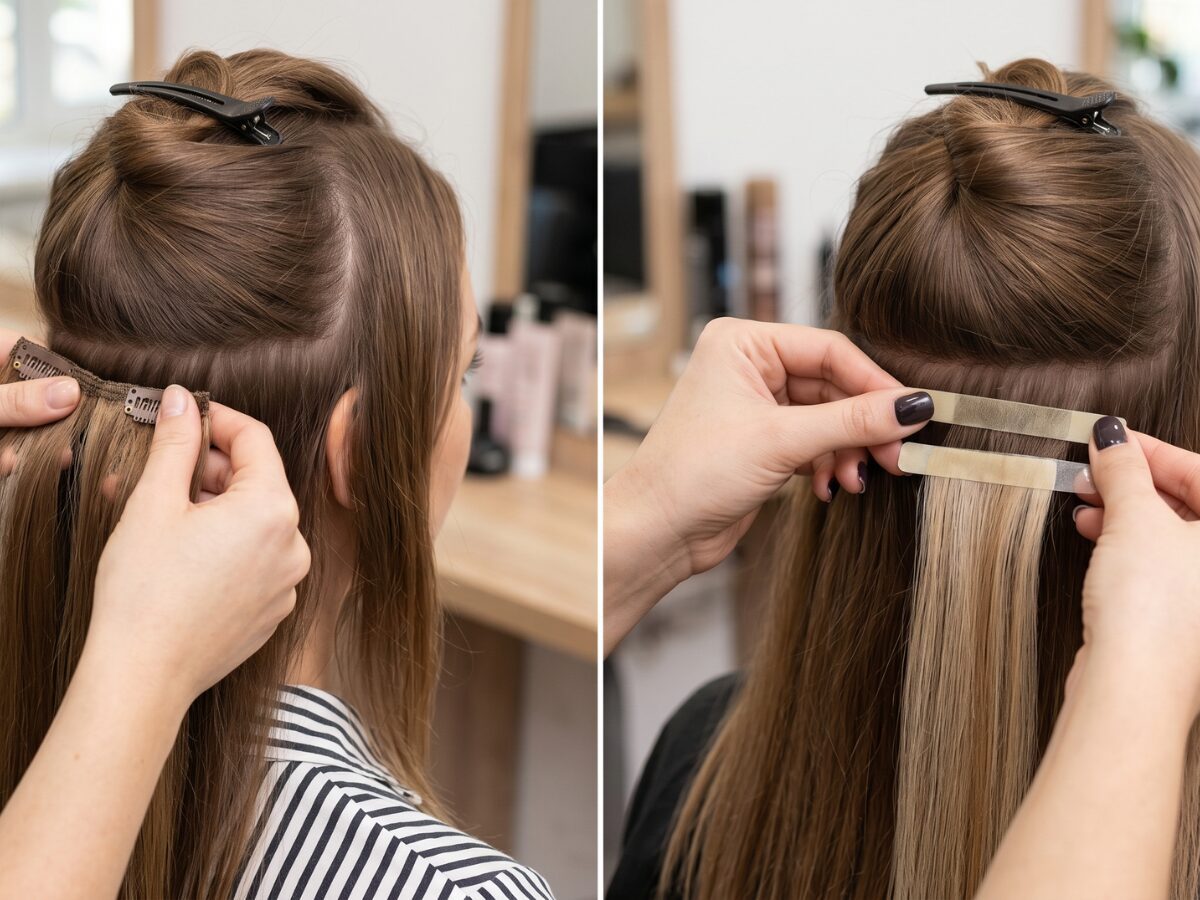
Choosing between clip-in vs tape-in extensions comes down to one question: how often do you want to wear them? Whether you want dramatic length for a night out in South Beach or everyday volume that survives Miami humidity, the right method depends on your lifestyle, your hair type and your budget. At Extension King Hair Salon & Shop on Alton Road, we fit both methods every week, so this guide shares what we actually see in the chair.
Choose clip-ins if you want extensions a few days a week, for events, or with zero commitment. Choose tape-ins if you want to wake up with fuller hair every day and don’t mind a salon visit every 6–8 weeks. Many of our clients end up owning both.
Clip-In vs Tape-In at a Glance
| Feature | Clip-In Extensions | Tape-In Extensions |
|---|---|---|
| Commitment | Temporary — in and out daily | Semi-permanent — 6–8 weeks per install |
| Who applies them | You, at home | A professional stylist |
| Application time | 5–10 minutes | 60–90 minutes in the salon |
| Sleep, shower, gym | Remove first | Keep them in |
| Feel | Can feel heavy by evening | Light and flat to the scalp |
| Visibility | Clips can show in fine hair or high updos | Very discreet when hair is down or in low styles |
| Upfront cost | Lower | Higher (hair + installation) |
| Ongoing cost | None | Move-up appointment every 6–8 weeks |
| Hair lifespan | 1+ year with good care | Wefts reusable 3–4 times |
| Damage risk | Low if removed nightly | Low if installed and removed by a pro |
| Best for | Events, beginners, occasional wear | Daily wear, busy routines, fine hair |
What Are Clip-In Hair Extensions?
Clip-ins are contoured wefts of hair with small, silicone-lined snap clips sewn along the top. You section your hair, snap each weft in close to the root, and let your natural hair fall over it. No glue, heat or appointment is needed, and they come out in seconds at night.
They are the easiest way to test a new length or add volume for a wedding, photoshoot or night out. Our clip-in hair extensions in Miami are 100% Remy human hair, color-matched in person, so they blend with your own texture instead of sitting on top of it. If you’re choosing a set, our guide to the best clip-in extensions for natural volume covers weight and weft layout.
Synthetic clip-ins are cheaper, but they can’t take real heat styling and lose their shine quickly in humid weather. Read our comparison of human hair vs synthetic extensions before you buy.

What Are Tape-In Hair Extensions?
Tape-ins are thin wefts with a medical-grade adhesive strip. A stylist sandwiches a fine section of your natural hair between two wefts, so the bond lies completely flat against the scalp. You can sleep, shower and work out with them, and they stay in for 6–8 weeks before being moved up as your hair grows.
Because the weight is spread across many small wefts, tape-ins feel light and are hard to detect by touch. Placement and removal need a professional, which is why we install our tape-in hair extensions in Miami in the salon with custom color matching and a full aftercare plan. Hair quality matters just as much as the method; here’s why we only use cuticle-aligned hair: Remy vs non-Remy hair.

Pros and Cons of Clip-In Extensions
Pros
- Zero commitment: wear them Saturday, skip them Monday.
- No salon fees: one purchase, no maintenance appointments.
- Long-lasting hair: because you wash them far less than your own hair, a quality human hair set can last well over a year.
- Styling freedom: curl, straighten and use any product.
- Easy to add more: pair them with clip-in ponytail and bun extensions for updos.
Cons
- Daily effort: 5–10 minutes in, and out again every night.
- Weight: a full set can feel heavy or tug on a sensitive scalp by evening.
- Styling limits: clips may peek through in high ponytails or windy weather.
- Not for sleep, showers or swimming.
Pros and Cons of Tape-In Extensions
Pros
- Wake-up-ready hair: no daily routine at all.
- Most discreet feel: flat bonds, no hardware at the root.
- Fine-hair friendly: light wefts spread the weight evenly.
- Active-life proof: stays in through workouts, showers and sleep.
- Reusable: the same hair can be re-taped 3–4 times.
Cons
- Salon maintenance: a move-up every 6–8 weeks.
- Higher upfront cost: hair plus professional installation.
- Product rules: no oils or heavy conditioner near the tapes.
- 48-hour wait: no washing right after installation while the bond sets.
- Styling limits: best worn down or in low styles; very high, tight ponytails can expose tabs.
Cost Comparison: Clip-In vs Tape-In Extensions
Price alone is misleading. Compare the upfront cost, the ongoing cost and, most usefully, the cost per day you actually wear them. For a wider view of the market, see our breakdown of premium hair extension costs in Miami.
| Clip-Ins | Tape-Ins | |
|---|---|---|
| Hair | $150–$400 [confirm] | $200–$600 [confirm] |
| Installation | $0 (optional stylist blend) | $200–$500 [confirm] |
| Maintenance | $0 | Move-up every 6–8 weeks: [your price] |
| Worn | Days you choose | Every day |
Cost per wear, a quick example: a $300 clip-in set worn three days a week for 18 months is about 230 wears — roughly $1.30 each time. Tape-ins cost more in year one, but because you wear them every single day, the cost per day of wear often ends up close. Rule of thumb: if you’d wear extensions five or more days a week, tape-ins give better value; one to three days a week, clip-ins win. Current salon packages are on our pricing page.
Do Clip-Ins or Tape-Ins Damage Your Hair?
Neither method damages healthy hair when it’s used correctly. Damage comes from habits, not the extension type. For the full picture, read do hair extensions damage your natural hair.
- Clip-in risks: sleeping in them, a set too heavy for your density, or clipping into the exact same spots every day. Rotate placement slightly and take them out every night.
- Tape-in risks: skipped move-ups (grown-out weight pulls at the root), DIY removal without adhesive remover, and tapes placed too close to the scalp. Keep your appointments and never peel tapes off yourself.
This is why every professional install at our salon comes with a personal aftercare plan — and why we offer the Extension King Damage Guarantee.
Which Is Better for Your Hair Type?
Thin or Fine Hair
Tape-ins usually win for daily wear: the wefts are light, flat and spread tension across the head. Clip-ins still work if you choose a lighter set and fewer wefts. Our guides to the best hair extensions for thin hair and extension methods for fine, fragile hair go deeper. If you’re experiencing active hair loss, book a consultation before choosing either.
Thick Hair
Thick hair hides clip-ins easily, though you may need a heavier set to see a difference. Tape-ins also work well but need more wefts for full coverage, which raises the cost. See our stylist tips on tape-in extensions for thick hair.
Short Hair
Clip-ins give you more control over where volume goes, but very short hair may not cover the clips. Tape-ins need enough length to hide each tab. Here’s what works best: extensions for short hair.
Curly and Textured Hair
Texture matching matters more than method. Clip-ins suit clients who switch between protective styles and natural hair; tape-ins commit you to a full 6–8 week cycle. Read what actually works for extensions for Afro-textured hair.
Clip-Ins vs Tape-Ins for the Miami Lifestyle
Heat, humidity, sweat and saltwater are part of daily life here, and they affect each method differently.
- Beach and pool days: clip-ins come out before you swim. Tape-ins can stay in, but rinse with fresh water right after and keep them dry for 48 hours after installation. Our full guide: can you swim with hair extensions.
- Humidity and sweat: tape-ins stay secure through workouts when you keep oils away from the bonds; clip-ins can slide if your roots get damp. More tips on extensions that don’t slip in Miami’s heat.
- Nights out and events: clip-ins are the fastest way to go from beach hair to gala hair.
Which Option Is Best for You?
Choose Clip-Ins If…
- You want extensions for weekends, events or date nights only
- You’re new to extensions and want to test length and volume first
- You’d rather not book salon appointments every two months
- You want the lowest total cost
- You’re planning a single event — for weddings, see our bridal hair extensions guide
Choose Tape-Ins If…
- You want fuller hair every morning with zero effort
- You work out, swim or have a busy schedule
- You’ve found yourself wearing clip-ins almost every day anyway
- You have fine hair and want lightweight, even volume
- You’re happy to visit the salon every 6–8 weeks
Can You Use Both?
Yes. Many of our clients wear tape-ins as their everyday base and add a clip-in piece for extra drama on special nights. Others start with clip-ins, learn which length they love, then switch to tape-ins. Clip-in wefts can’t be converted into tape-ins, but your set is never wasted — it becomes your event piece.
A Third Option: Cold-Pressed Extensions
If you want tape-in convenience without adhesive, ask about our signature Cold-Pressed extensions. This strand-by-strand method uses no glue, heat or chemicals, so it suits clients with sensitive scalps or fine hair who want long wear. Comparing semi-permanent methods? Read I-Tip vs Tape-In next.
Maintenance and Care Tips
Clip-Ins
- Brush from the ends upward with a soft-bristle or loop brush.
- Wash every 15–20 wears with sulfate-free shampoo; air-dry flat.
- Store flat or on an extension hanger in a cool, dry place.
- Use heat protectant before any hot tool.
Tape-Ins
- Wait 48 hours after installation before washing.
- Condition from mid-lengths down; keep oils away from the tapes.
- Brush twice daily with an extension brush, holding the bonds.
- Never sleep on wet hair; braid loosely before bed.
- Keep every move-up appointment.
Common Mistakes to Avoid
- Sleeping in clip-ins — constant tension at the root can lead to traction hair loss.
- Oils on tape bonds — the adhesive loosens and wefts slip.
- DIY tape installation or removal — the most common cause of breakage we fix.
- Choosing by price alone — cheap non-Remy hair tangles and dulls fast in humidity.
- Skipping color matching — a shade off at the ends is the fastest giveaway.
Frequently Asked Questions
Which is better, clip-in or tape-in extensions?
Neither is better for everyone. Clip-ins suit occasional wear and zero commitment; tape-ins suit everyday wear and busy routines. The right choice depends on how many days a week you want extensions.
Are clip-in extensions damaging?
Not when worn correctly. Remove them before bed, rotate placement, and choose a weight that matches your hair density.
How long do tape-in extensions last?
Each installation lasts 6–8 weeks before a move-up. With good care, the same wefts can be re-taped 3–4 times.
Which is better for thin hair?
Tape-ins are usually the better daily option because the flat, light wefts spread weight evenly. A light clip-in set works well for occasional wear.
Can you sleep and swim with tape-in extensions?
Yes. Wait 48 hours after installation, braid loosely at night, and rinse with fresh water after the ocean or pool. Clip-ins should always come out first.
Can you heat-style both types?
Yes, if they are human hair. Use a heat protectant, and keep hot tools away from tape bonds.
Which costs more over time?
Tape-ins cost more per year because of installation and move-ups. If you’d wear extensions five or more days a week, the cost per day of wear is often similar.
Can I switch from clip-ins to tape-ins?
Yes. Many clients start with clip-ins, then move to tape-ins once they know their ideal length and shade. Keep your clip-ins for events.
Conclusion: Find Your Perfect Match in Miami
Clip-in extensions in Miami Beach offer flexibility for temporary styling, while tape-in hair extensions in Miami Beach provide effortless, everyday fullness. Both options look natural when you choose quality human hair, match your shade correctly, and follow proper care.
